


Transporting flowers without losing their vibrancy is challenging. Florists use precise techniques to prevent dehydration, temperature damage, and physical harm. Here's how they do it:
- Hydration: Flowers are trimmed at a 45° angle, placed in water with flower food, and conditioned for 4–12 hours.
- Temperature Control: Flowers are stored and transported between 32–36°F for most varieties, with tropical flowers requiring 41–55°F.
- Packaging: Buckets, floral foam, and water tubes keep arrangements stable and hydrated. Mesh nets and tissue paper protect petals.
- Securing During Transit: Sandbags, wooden racks, and non-slip mats prevent tipping. Seatbelts or custom holders stabilize larger arrangements.
- Ethylene Management: Sensitive flowers are kept away from ethylene producers to delay aging.
These steps ensure flowers remain vibrant and long-lasting upon arrival, similar to how you can keep fresh cut flowers alive longer at home.
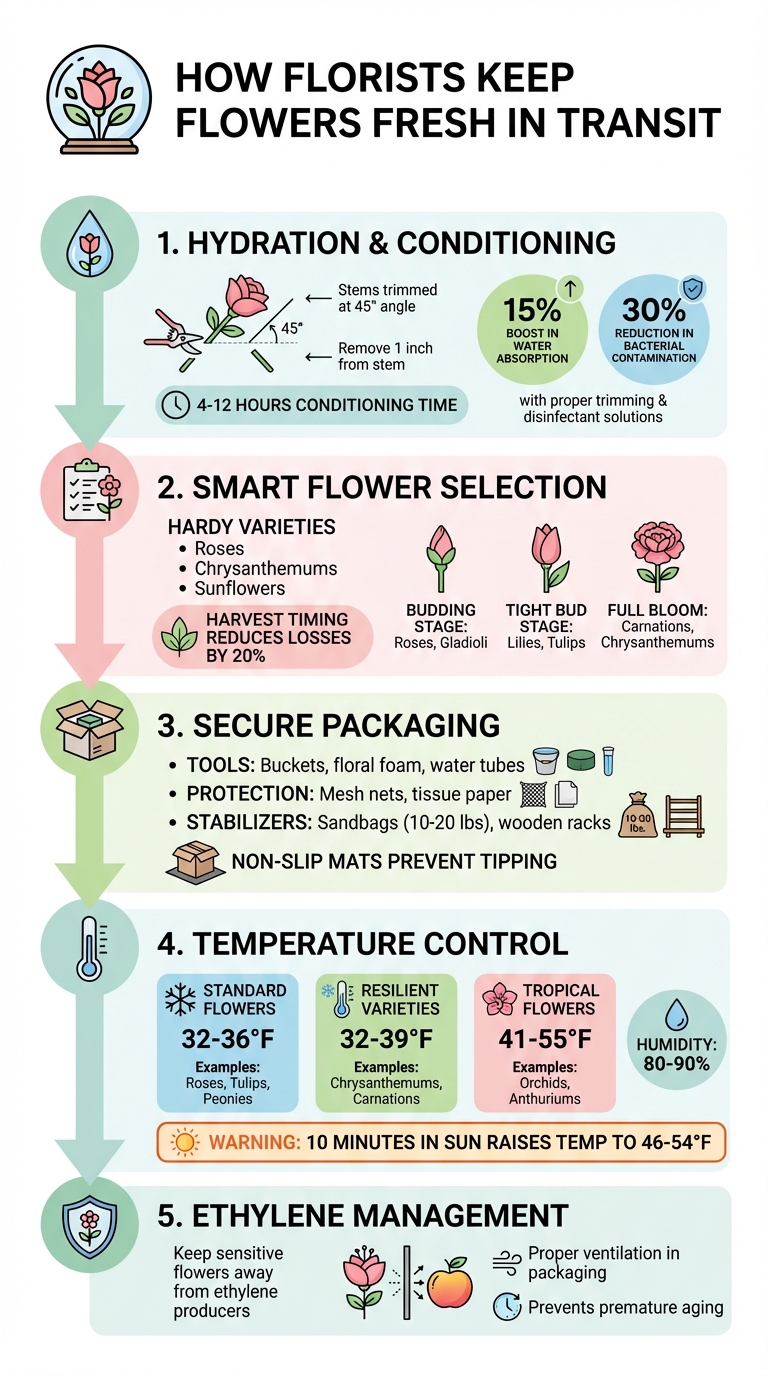
5 Essential Steps Florists Use to Keep Flowers Fresh During Transit
How I Transport My Flower Arrangements And Bouquets! 🌸💐 | Simply Bloom
sbb-itb-2be19a4
Preparing Flowers Before Transport
Getting flowers ready for transport isn't just about packing them up and shipping them off. At Marietta Floral Design, the process starts with proper hydration, ensuring each bloom is primed for the journey. This step is crucial because it builds up the moisture reserves flowers need to stay fresh during transit, making packaging and temperature control even more effective.
Hydrating and Conditioning Flowers
The moment flowers arrive, hydration begins. Florists waste no time removing blooms from their shipping boxes and placing them in water - every second counts. Stems are trimmed at a 45-degree angle, with about an inch removed. Why the angle? Liza Roeser, Founder of FiftyFlowers, explains:
"An angled cut creates a larger surface area for water absorption and prevents your stems from sitting flat in the container which will block water absorption".
Leaves below the waterline are also removed to prevent bacterial growth, which can contaminate the water and cause flowers to wilt faster. Once trimmed, the stems are placed in clean buckets filled with at least four inches of cool water mixed with flower food. This mixture usually contains sugars for energy, acidifiers to improve water uptake, and antimicrobial agents to keep bacteria at bay. Studies show that proper stem trimming with sharp tools can boost water absorption by 15%, while disinfectant solutions containing glucose and Vitamin C can reduce bacterial contamination by 30%.
Flowers typically need 4 to 12 hours of hydration at room temperature before they’re moved to cold storage or sent out for delivery. Eric Santos, Owner of Santos Flowers, shares his approach:
"We let our flowers hydrate for about an hour at room temperature so they're able to take in enough water before we put them in the walk-in cooler".
This conditioning process ensures flowers have the moisture reserves they need to stay fresh during their journey. After conditioning, selecting varieties that can handle the challenges of transport is the next step in keeping blooms in top shape.
Selecting Flowers That Travel Well
Not every flower is built for the road. Hardy varieties like roses, chrysanthemums, and sunflowers are often chosen for long-distance transport because they can handle the bumps and temperature changes along the way. Timing also plays a big role in how well flowers travel. For instance, roses and gladioli are best cut at the budding stage - just starting to open - so they can continue blooming during transit and arrive ready for display. Research shows that cutting roses at the right budding stage can reduce product losses by 20%.
Delicate flowers like lilies and tulips should be harvested at a very tight stage since they tend to open and develop color even in climate-controlled transport. As Nancy Viseth from South County Flowers puts it:
"Designers appreciate receiving blooms in a tight bud stage unless they specifically request otherwise".
On the other hand, flowers like carnations and chrysanthemums are better selected at full bloom. These varieties hold their decorative appeal longer, and selecting carnations with unopened buds is a mistake - they won’t open further once placed in a vase.
| Flower Type | Optimal Selection Stage | Travel Resilience |
|---|---|---|
| Roses | Budding stage | High |
| Chrysanthemums | Full bloom | High |
| Carnations | Full bloom | High |
| Sunflowers | Open | High |
| Lilies | Tight bud stage | Moderate |
| Tulips | Very tight stage | Moderate |
| Gladioli | Budding stage | Moderate |
| Poppies | Not recommended | Low |
| Peonies | Not recommended | Low |
Another factor to consider is ethylene sensitivity. Some flowers, like daffodils, are especially sensitive to ethylene gas, which speeds up aging. These blooms must be kept away from high-ethylene producers like carnations during packing. By carefully selecting and preparing flowers, florists can ensure their arrangements arrive fresh and beautiful, no matter the distance.
Handling and Securing Flowers During Transit
Once flowers are hydrated and carefully selected, the next hurdle is ensuring they stay safe and intact during transit. Damage like tipping, crushing, or water spillage can ruin an arrangement before it even arrives. Professional florists rely on specific tools and techniques to keep arrangements stable and protected on the move.
Using Buckets, Foam, and Water Tubes
The right container makes all the difference. For long-stemmed flowers like delphiniums and sunflowers, tall, narrow 5-gallon buckets are ideal. They help keep stems upright and prevent tangling. On the other hand, smaller 3-gallon buckets work well for pre-arranged vases, offering them better stability during transport.
When buckets aren't an option - like with large event pieces such as floral arches - floral foam becomes a lifesaver. It stabilizes intricate designs while keeping flowers hydrated. For smaller bouquets or single stems, water tubes or stems wrapped in wet cotton (sealed in plastic bags) provide hydration without the bulk of a bucket.
Delicate flowers like roses and lilies require extra care. Mesh flower nets are often used to protect their petals from bruising. Rubber bands can also secure stems, keeping them from sagging during the journey.
But securing the arrangements in the vehicle is just as important as choosing the right containers.
Preventing Tipping and Crushing
Once the flowers are packed, the next step is to prevent movement during transit. This means making use of every available stabilizing method. Nancy Viseth, owner of South County Flowers, emphasizes:
"Every bit of real estate in your vehicle should be covered with full or empty buckets, so there is no room for anything to tip over or slide around".
To keep buckets stable, florists often place 10- to 20-lb weights like sandbags or filled water bottles around their bases. Custom wooden racks, dividers, non-slip mats, and even simple materials like rolled-up towels, bubble wrap, or crumpled newspaper help reduce shifting and absorb shocks during transport.
Vehicle placement is another key factor. Placing flowers on the floorboard lowers the center of gravity, offering better stability. For larger vases, seatbelts can be looped around them to keep them secure. A creative alternative is the "X" cutout method: cutting X-shaped holes into sturdy cardboard box lids creates custom-sized holders that keep vases upright.
| Tool/Material | Primary Purpose | Best For |
|---|---|---|
| Tall, Narrow Buckets | Support and hydration | Long-stemmed flowers (Delphinium, Sunflowers) |
| Floral Foam | Stability and hydration | Large event pieces and arch arrangements |
| Water Tubes | Transit hydration | Single blooms or bouquets without a vase |
| Sandbags (10-20 lbs) | Anti-tipping | Securing heavy buckets in delivery vans |
| Wooden Racks | Organization and stability | Transporting multiple vases or containers |
| Mesh Flower Nets | Petal protection | Delicate blooms like Roses and Lilies |
Christine Foley, a floral designer with over 30 years of experience, turned her frustrations into innovation. As the inventor of The Flower Caddy, she created a specialized tool designed to fit specific dish sizes and prevent tipping. Reflecting on her journey, she shared:
"As a florist and designer for over 30 years, I was tired of spending my time and money trying to figure out a temporary jerry-rigged solution to deliver high-end centerpieces".
Her invention, featuring stackable and secure designs, represents a move toward professional-grade transport solutions that are gaining traction in the industry.
Controlling Temperature During Transport
When it comes to transporting flowers, temperature control is everything. Even the most secure packaging can't save flowers if the temperature fluctuates too much. High heat accelerates aging, while extreme cold can harm delicate petals. Any disruption in the cold chain can drastically cut down a flower's vase life. That's why keeping flowers within the right temperature range is essential to slow aging and preserve their vibrant appearance.
Temperature Ranges for Different Flowers
Different flowers have different temperature needs, and knowing these ranges is key to keeping them fresh. For standard cut flowers like roses, tulips, and peonies, the ideal range is between 32°F and 36°F. This helps slow their respiration and maintain their freshness. Hardier flowers, such as chrysanthemums and carnations, can handle slightly warmer conditions, up to 39°F.
Tropical flowers, including orchids and anthuriums, are much more sensitive. They must be kept between 41°F and 55°F to avoid freezer burn and maintain their delicate structure. Mir Bakhramov from Cargo Flowers explains:
"Ten minutes under the sun can raise the internal temperature of a flower box to 46–54°F. Externally, the flowers may look perfect, but their lifespan is already reduced."
| Flower Type | Temperature Range | Examples |
|---|---|---|
| Standard Cut Flowers | 32–36°F | Roses, Tulips, Peonies |
| Resilient Varieties | 32–39°F | Chrysanthemums, Carnations |
| Tropical Varieties | 41–55°F | Orchids, Anthuriums |
In addition to temperature, maintaining humidity levels between 80% and 90% is crucial to prevent petals from drying out or wilting during transport. These precise requirements highlight the importance of specialized cooling techniques for flower shipments.
Using Refrigerated Vehicles and Insulated Containers
To meet these strict temperature and humidity standards, florists depend on refrigerated vehicles and insulated containers. For instance, florists in Metro Atlanta, like Marietta Floral Design, use temperature-controlled vehicles equipped with advanced systems to regulate cooling and humidity. These vehicles ensure the stable conditions flowers need to stay fresh. Anthony Richardson from Spelman Logistics notes:
"Temperature-controlled vehicles are equipped with advanced cooling systems that maintain a consistent climate, tailored specifically for transporting perishable goods like flowers."
Before flowers are loaded for transport, they often go through a pre-cooling process to quickly bring them to 36°F–39°F. This step slows their metabolism, extending their shelf life. For shorter trips or last-mile deliveries, insulated containers lined with foam, bubble wrap, or double-wall corrugated boxes help protect the arrangements from sudden temperature changes.
Many florists are also turning to IoT sensors to monitor real-time conditions inside delivery vehicles. These sensors send instant alerts if temperatures drift outside the target range, allowing drivers to make adjustments immediately.
The key to keeping flowers fresh is maintaining the cold chain for as long as possible. As Bakhramov emphasizes:
"The core principle is simple: the less time cargo spends outside the cold chain, the longer the flowers live."
Packaging Methods for Flower Arrangements
Once temperature control and flower preparation are handled, packaging becomes the final step to safeguard blooms during transit. The right materials protect petals, stabilize stems, and keep arrangements intact. Without proper wrapping and cushioning, even the best-conditioned flowers risk arriving damaged or wilted.
Wrapping and Cushioning Flowers
Florists use specific wrapping materials that balance durability and aesthetics. Kraft paper is a rustic, waterproof choice, while Korean-style matte wrap paper offers better structure than traditional cellophane. For fragile flowers like roses and lilies, mesh nets help prevent petal bruising.
A newer favorite is honeycomb wrap paper, known for its stretchable, perforated design that cushions stems while allowing airflow. Inside boxes, materials like tissue paper, bubble wrap, and foam keep arrangements secure. To ensure hydration, stems are often cut at an angle just before packing, increasing their ability to absorb water.
To maintain moisture, packaging may include water tubes, wet cotton, or floral gel packs. Transparent, waterproof sleeves protect stems from dirt while keeping them visible. Many florists are now switching to biodegradable materials to align with eco-conscious practices.
More intricate arrangements or larger pieces often need additional steps for secure packaging.
Packaging Vases and Large Arrangements
Shipping vases and oversized arrangements requires extra care to ensure stability. Double-wall cardboard boxes with reinforced corners provide a strong base to absorb shocks during transport. Inside the box, tools like automatic vase holders or pyramid-shaped stabilizers keep containers upright, while waterproof liners or plastic sheets catch leaks and protect the packaging.
In delivery vehicles, arrangements are further secured with non-slip mats or straps to prevent tipping. Boxes are sealed tightly with strong packing tape, and proper ventilation is maintained to avoid ethylene gas buildup, which can speed up wilting. For local deliveries in Metro Atlanta, Marietta Floral Design combines these packaging techniques with temperature-controlled vehicles to ensure flowers arrive in perfect condition.
Conclusion
Delivering fresh flowers requires careful attention to hydration, temperature, and secure packaging. Each step, from preparing the stems to the final handoff, plays a critical role in preserving the beauty of every bouquet.
The process involves more than just transport - it’s about managing ethylene levels, retaining moisture, and using protective materials to keep flowers vibrant during the journey. These thoughtful practices set professional florists apart from casual delivery services.
At Marietta Floral Design, these methods are combined to ensure every arrangement reaches its destination in perfect condition across Metro Atlanta. By using locally sourced blooms, skilled hand-delivery, and strict transport protocols, each bouquet becomes a special gift that leaves a lasting impression.
So, the next time a bouquet arrives looking freshly picked, take a moment to appreciate the care and expertise behind it. Every petal is a testament to the artistry of quality flower delivery.
FAQs
How can I keep flowers fresh during a long drive?
To keep flowers fresh on a long drive, aim to maintain a cool environment. If you can, use an air-conditioned vehicle or even a refrigerated van for better temperature control. Ideally, keep the temperature around 30°F during longer trips. Place the flowers in water-filled containers to keep them hydrated and secure them to prevent unnecessary movement. If space is tight, removing the back seats can create extra room. Lastly, ensure proper ventilation to avoid overheating, as excessive heat can quickly cause delicate flowers to wilt.
What temperature is too cold or too hot for cut flowers?
Extreme temperatures - anything above 95°F or below -15°F - can be tough on cut flowers. High heat ramps up respiration, making flowers wilt more quickly. On the flip side, freezing temperatures can leave stems brittle or even cause freezer burn. To keep flowers fresh during transport, it's crucial to stick to a moderate temperature range.
Which flowers travel best for delivery or events?
Flowers such as chrysanthemums, lisianthus, tulips, and roses are excellent options for delivery or events. Their durability and ability to remain fresh during transit make them reliable choices for ensuring floral arrangements look their best upon arrival.