


When words fail during times of loss, flowers can express care and support. Choosing the right sympathy flowers involves understanding their meanings, selecting appropriate colors, respecting traditions, and considering practical details. Here's a quick summary:
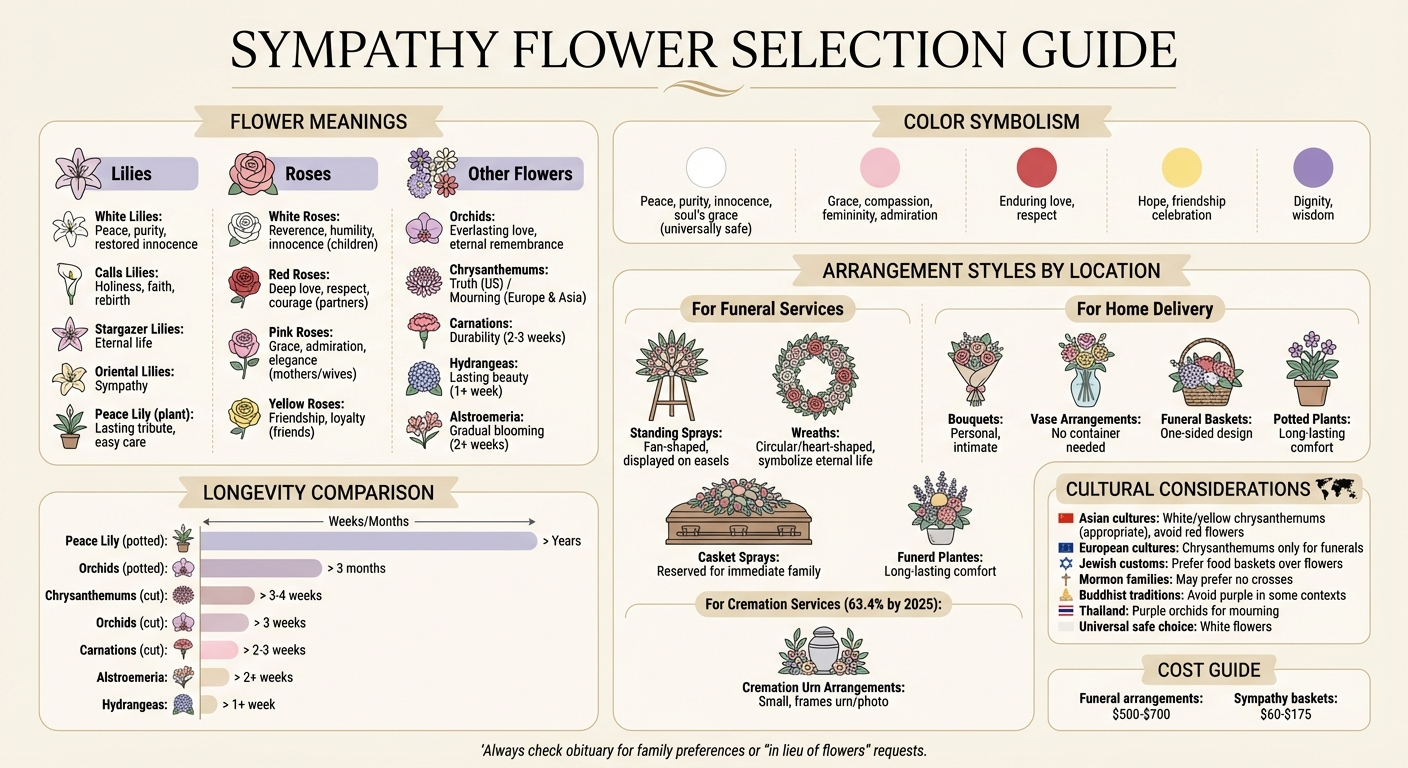
- Flower Meanings: White lilies symbolize peace, pink roses show grace, and orchids represent eternal love.
- Color Choices: White conveys purity, pink adds warmth, while red, yellow, or purple carry specific sentiments.
- Cultural Sensitivity: Chrysanthemums are linked to mourning in Asia and Europe, while orchids are widely respectful.
- Longevity: Potted plants like peace lilies or orchids last longer than cut flowers.
- Arrangement Styles: Wreaths and sprays suit services; bouquets and baskets work for homes.
- Recipient Consideration: Tailor flowers to the family’s preferences and delivery location.
- Local Florists: Collaborate for personalized arrangements that reflect the deceased’s personality.
Sympathy flowers not only honor the departed but also offer comfort to grieving families, making thoughtful selection essential.
Sympathy Flower Meanings and Color Guide: Choosing the Right Flowers for Funerals
Let's talk about sympathy flowers
sbb-itb-2be19a4
1. Learn What Lilies and Roses Mean
Lilies have long been associated with restored innocence and purity, making them a meaningful choice for many occasions. Among them, white lilies stand out as a respectful and timeless option.
Different types of lilies carry unique meanings. For instance:
- Calla lilies symbolize holiness, faith, and rebirth.
- Stargazer lilies are linked to eternal life.
- Oriental lilies convey sympathy.
Roses, on the other hand, communicate emotions through their colors:
- White roses signify reverence, humility, and innocence, making them ideal for traditional ceremonies or honoring a child's memory.
- Red roses express deep love, respect, and courage, often chosen for spouses, partners, or close family members.
- Pink roses represent grace, admiration, and elegance, offering a heartfelt tribute for mothers or wives.
- Yellow roses symbolize friendship and loyalty, a fitting way to celebrate a dear friend’s life.
While lilies focus on the spiritual journey of the deceased - symbolizing peace and innocence - roses allow you to reflect your personal connection, whether it’s romantic love, gratitude, or friendship.
For a lasting tribute, consider gifting a Peace Lily plant instead of traditional cut flowers. This living symbol of support is easy to care for and serves as an enduring reminder.
Up next, discover how the colors in your arrangement can add even more depth to your sentiment.
2. Pick the Right Colors Like White and Pink
Colors carry deep emotional resonance, especially in times of grief. Among them, white has long been the most traditional and universally accepted choice for sympathy arrangements. It symbolizes peace, purity, innocence, and the soul's return to grace. White flowers create a tranquil and soothing presence, making them appropriate for both religious and non-religious services.
"White flowers are a safe and respectful choice for any sympathy arrangement as they represent peace, purity, and innocence." - Mariam's Flowers
Pink, on the other hand, offers a softer, more personal touch. It conveys grace, admiration, and compassion, making it especially fitting for honoring the loss of a mother or wife. The color pink reflects femininity and beauty while also expressing gratitude for the profound impact of the departed.
Other colors can also add layers of meaning. Red represents enduring love, yellow brings a sense of hope and celebrates friendship, and purple conveys dignity and wisdom.
For a thoughtful and balanced arrangement, consider blending white and pink flowers. The serene elegance of white paired with the gentle warmth of pink creates a message that honors both the solemnity of loss and the celebration of a cherished life.
Next, we’ll look at how traditions and customs can further influence your choices.
3. Respect Different Traditions with Chrysanthemums and Orchids
Flower meanings often depend on cultural perspectives - what feels comforting in one culture might carry a completely different message in another. Take chrysanthemums, for example. In the United States, they generally represent truth and are seen as cheerful and uplifting. But in many European countries, including France, Italy, Spain, and Germany, chrysanthemums are strictly associated with funerals and gravesites. Offering them to someone alive could be considered unlucky.
"In many Asian countries, white chrysanthemums are seen as a symbol of grief while in European countries, they're seen as a symbol of death and because of this, they're only used for memorials and graves." - Devlin Funeral Home
Chrysanthemums and orchids also carry strong cultural significance in mourning traditions. In China, Japan, and Korea, white and yellow chrysanthemums are commonly used to express grief, making them a traditional choice for funerals. On the flip side, red flowers are best avoided when sending arrangements to East Asian families, as they don't align with mourning customs.
Orchids, however, tend to be a safer and more universally respectful option for sympathy gestures. They symbolize everlasting love and are particularly meaningful when someone has lost a spouse or partner. White and pink orchids are especially fitting, as they convey remembrance, innocence, and compassion across many cultural contexts. Phalaenopsis and Dendrobium orchids are popular choices for sympathy arrangements. In Thailand, purple orchids are a thoughtful option, as purple is traditionally linked to mourning.
Before sending flowers, it’s always a good idea to consider the recipient’s cultural background. For instance, in some Buddhist traditions, purple represents preciousness rather than mourning, and cross-shaped arrangements might not be appropriate for Mormon services. When in doubt, white flowers are a timeless and universally respectful choice.
4. Select Flowers That Last Like Orchid Plants or Hydrangeas
When offering comfort to someone grieving, the choice of flowers matters. Blooms that last longer can provide ongoing solace, unlike those that wither quickly. For example, chrysanthemums and carnations are among the most durable cut flowers - chrysanthemums can remain fresh for three to four weeks, while carnations typically last two to three weeks. Their sturdy stems and thick petals also make them resilient against outdoor conditions like wind and sunlight, making them suitable for gravesites as well.
For even greater longevity, consider potted plants. These not only outlast traditional cut flowers but also serve as lasting tributes. Cut orchids, for instance, can last up to three weeks, but potted orchids can bloom for as long as three months. Peace lilies are another excellent option, as they can thrive for years with proper care, offering a continual reminder of sympathy and support.
Hydrangeas, with proper hydration, can last over a week. Their woody stems may require occasional misting to improve water absorption. For a different touch, alstroemeria (or Peruvian lilies) is a great choice. These flowers can last two weeks or more, with their buds continuing to open gradually over time.
Interestingly, the rise in cremation - expected to reach 63.4% by 2025 - has influenced a shift in floral traditions. Many families now opt for long-lasting potted plants to place in home memorial niches instead of traditional graveside arrangements. These living tributes not only honor loved ones but also offer a therapeutic outlet, as caring for the plant can help ease the grieving process.
5. Choose the Right Style Like Wreaths or Bouquets
Once you've picked the perfect flowers, the next step is choosing an arrangement style that complements the sentiment you want to express.
Each arrangement style carries its own meaning and is suited to specific settings. For example, funeral flowers are often large, formal displays - like standing sprays and wreaths - designed for services. On the other hand, sympathy flowers are smaller, more personal gestures, such as bouquets or potted plants, typically sent to a family’s home or workplace. The style you choose adds depth to the message conveyed through your floral gift.
Standing sprays are fan-shaped arrangements displayed on easels, designed to be seen from a distance during services or at gravesites. These are often chosen as a collective tribute from close friends, family, or coworkers. Wreaths, whether circular or heart-shaped, symbolize eternal life and are typically placed near the casket. They’re a fitting choice for close friends or family members. Casket sprays, which rest directly on the casket, are generally reserved for immediate family.
For home delivery, bouquets, vase arrangements, or funeral baskets are thoughtful choices. These options brighten up a home and don’t require additional containers. Funeral baskets, in particular, feature a one-sided design that works well on floors or tables at the service, offering a personal tribute from friends or extended family.
With cremation becoming more common - projected to reach 63.4% by 2025 - cremation urn arrangements are increasingly popular. These smaller floral designs are meant to frame or accent an urn or photograph, making them perfect for the more intimate setting of a celebration-of-life event.
Another meaningful gesture is sending flowers to the family’s home about a week after the service. This thoughtful act provides comfort and support during a time when condolences often begin to dwindle.
6. Think About the Recipient and Delivery Location
When ordering flowers, it's important to consider both the recipient's preferences and the delivery location. Start by reflecting on your relationship with the deceased or their family. If you shared a close bond, a larger arrangement - like a standing spray or wreath - might be more appropriate for a funeral home. For acquaintances or colleagues, a smaller bouquet or a potted plant sent to their home can be a thoughtful and fitting gesture. Whenever possible, include the deceased's favorite flowers or colors to add a personal touch. It's also essential to respect any traditions or customs that might influence your choice.
Cultural and religious practices often play a significant role in selecting flowers. For example, in Jewish customs, flowers are typically not suitable for shiva or burials, where food baskets are preferred instead. Similarly, some Mormon families may prefer arrangements without crosses or crucifixes. In Buddhist traditions, purple flowers are often avoided, while in many Asian cultures, white and yellow chrysanthemums are favored, and red flowers might be seen as inappropriate. Always check the obituary for specific requests, such as "in lieu of flowers" or suggestions for charitable donations.
As Funeral.com wisely states:
"The most polite flower choice is the one that matches what the family has asked for - even if what they asked for is 'please don't.'"
The delivery location also impacts your decision. Funeral homes are ideal for larger, formal displays like standing sprays and wreaths, while smaller, portable arrangements such as vase bouquets, baskets, or potted plants are better suited for delivery to homes. Avoid sending standing sprays to residences. If you're sending flowers to a hospital, confirm whether the ICU permits flower deliveries. For graveside services, opt for baskets or plastic vases, as many cemeteries prohibit glass containers for safety reasons.
Always call the funeral home to ensure flowers are accepted, confirm delivery windows, and verify service times. For workplace deliveries, a single high-quality arrangement is more thoughtful than multiple smaller ones. Sending flowers to the family's home a week after the service can also provide ongoing comfort and show that you're still thinking of them during this difficult time.
7. Work with Local Florists for Custom Neutral or Pastel Arrangements
Personalizing a floral tribute adds a deeper layer of meaning and support during difficult times. Collaborating with a local florist allows you to create arrangements that uniquely honor a loved one's memory. Local florists often design pieces that tell a story, reflecting the individuality of the person being remembered. Heather Tombs of Winnie & Olive Blooms in Kinver, England, describes her personalized approach:
"I don't have a catalog of floral designs because each family is unique. Once I have an idea, I speak with local flower farmers to source the right flowers."
In August 2023, Tombs crafted custom sympathy arrangements that included vintage football boots for a soccer fan, an edible floral tribute for a horse enthusiast, and a casket spray featuring chili peppers and garlic for someone passionate about cooking.
Neutral and pastel tones are often chosen for their elegance and symbolism. White flowers represent peace and purity, while soft shades like pink, lavender, and cream bring a sense of grace and compassion, offering what many describe as a "soft embrace" for grieving families .
Local florists also prioritize freshness by sourcing blooms from nearby farmers. This not only ensures that the arrangements stay vibrant throughout the service but also supports local growers . Their expertise shines through in the thoughtful details of every arrangement.
Face-to-face consultations with florists can provide emotional comfort as well. Melissa Comito-Aakre of Umulig Bukett in Sandnes, Norway, shared her experience designing her own sister's funeral flowers:
"Many people have told me that they made it through the funerals of their loved ones by looking at the flowers I designed. Each felt his or her loved one was there."
When ordering, share personal details about the deceased - favorite colors, hobbies, or cherished memories - so the florist can incorporate these elements into the arrangement . Seasonal blooms are often fresher and more affordable than imported flowers, so ask your florist about locally available options . To avoid rush fees and ensure the florist has time to source specific flowers, place your order as soon as the service details are finalized. Generally, funeral flower arrangements cost between $500 and $700, with simpler sympathy baskets ranging from $60 to $175.
Conclusion
Choosing the right sympathy flowers requires care and thoughtfulness. A well-chosen arrangement can express emotions that words often cannot, offering comfort in times of deep loss. Understanding the symbolism of flowers - like lilies for peace, roses for love, and orchids for eternal remembrance - helps create a meaningful tribute to honor a loved one.
Color selection is equally important. White and pastel shades are commonly associated with calm and reverence, while richer tones can signify strength and respect. It’s also essential to consider cultural and religious traditions, as these can influence flower choices. When in doubt, consulting a florist familiar with these nuances can ensure your arrangement is respectful and appropriate.
Practical details, such as the delivery location, also play a role in selecting the right arrangement. For instance, large displays like wreaths or standing sprays are typically suited for funeral services, while smaller bouquets or potted plants, such as peace lilies or orchids, are often more fitting for home delivery. These thoughtful gestures can provide a lasting reminder of your care and support.
"Sympathy flowers are more than decoration; they're an expression of care, respect, and remembrance."
Working with a local florist allows you to add personal touches that reflect cherished memories. Including a heartfelt note can further personalize your gesture, offering sincere support during a challenging time.
FAQs
What flowers should I avoid for certain cultures or religions?
Some flowers might not be suitable in certain religious or cultural settings. For instance, white or yellow chrysanthemums are often associated with Chinese funerals, making them inappropriate for other occasions. Similarly, red flowers can carry negative connotations in some Asian traditions, and bright, celebratory blooms - like neon-colored flowers - might be seen as disrespectful during periods of mourning. It's important to keep these sensitivities in mind to ensure your floral gesture is both thoughtful and respectful.
When should I send sympathy flowers if I missed the service?
If you weren’t able to attend the service, sending sympathy flowers afterward is a thoughtful gesture. Grief doesn’t end with the funeral, so flowers can be sent at any time to show your support and care. You might choose to send them to the family’s home or another place that holds significance, offering a touch of comfort during a difficult time.
How do I choose the right arrangement size for my relationship?
When choosing a floral arrangement, think about the occasion and the space it will occupy. Smaller arrangements (around $45-$55) are perfect for personal gestures or compact spaces like desks. Medium-sized options ($65-$75) fit well on kitchen counters or coffee tables, offering a balanced presence. For more formal events or spacious areas, larger arrangements ($85-$100) make a statement.
Sympathy flowers often reflect the depth of your support. Larger arrangements, typically over 30 inches, express a more pronounced sentiment, while smaller ones, under 16 inches, provide a more personal and intimate touch.