


Minimalist floral design is redefining wedding aesthetics in 2026. Couples are opting for fewer, high-quality blooms that emphasize simplicity, texture, and natural beauty. This approach prioritizes single-stem arrangements, soft monochromatic palettes, and sculptural flowers like orchids and calla lilies. Sustainability is also key, with locally sourced blooms and reusable materials gaining popularity. Key trends include:
- Neutral tones: Ivory, cream, and off-white shades layered for depth.
- Soft pastels: Pale lemon, blush, and sage tones for subtle warmth.
- Single-stem designs: Bold, impactful arrangements with fewer flowers.
- Statement blooms: King proteas, anthuriums, and calla lilies as focal points.
- Smaller bouquets: Petite arrangements highlighting quality over volume.
- Hanging installations: Dramatic overhead displays using lightweight materials.
This year's wedding florals focus on refined elegance, architectural forms, and eco-conscious choices, creating a modern yet timeless look.
2026 Floral Trends You Need to See (Luxury Edition)
sbb-itb-2be19a4
Color Palettes for Minimalist Wedding Flowers
When it comes to minimalist wedding flowers, the color palette plays a crucial role in refining the overall aesthetic. In 2026, couples are leaning toward understated, intentional designs that emphasize texture and tonal depth rather than bold contrasts. These palettes allow each bloom to shine, creating arrangements that feel both modern and timeless.
Neutral Tones: Ivory, White, and Off-White
Neutral tones remain a staple of minimalist wedding design, but they’ve evolved beyond simple all-white arrangements. Florists are now layering shades like ivory, cream, and off-white to craft what’s being called "Cloud Dancer" neutrals. This layered approach feels sophisticated and editorial while maintaining a timeless appeal.
To achieve this look, florists combine blooms like garden roses, lisianthus, and orchids, focusing on complementary textures. For instance, the smooth elegance of calla lilies pairs beautifully with the ruffled charm of ranunculus, while sleek anthuriums contrast with the velvety petals of anemones. Green accents, such as viburnum or green orchids, are no longer just fillers - they’re integral to the design, adding freshness and depth.
Soft Pastels: Pale Lemon, Blush, and Sage
Soft pastel tones are another way to introduce subtle warmth and charm to minimalist arrangements. A standout shade for 2026 is "Buttermilk Yellow", a pale, sunlit lemon that offers a softer alternative to beige. As Rinlong Flower puts it:
Buttermilk Yellow (a pale, sunlit lemon) is the new neutral. It feels like sunshine without the aggression of bright gold.
Blush tones, ranging from soft pink to dusty rose and even deeper mauves, add richness and depth. Meanwhile, sage green pairs effortlessly with lilac, cream, or taupe, creating what designers call the "Duna" aesthetic - an earthy, grounded look with an architectural edge. These hues work best with sculptural flowers and long silk ribbons that introduce movement without overwhelming the arrangement.
Single-Tone Designs
For those seeking the ultimate minimalist statement, monochromatic arrangements deliver unmatched elegance. Using a single color family - whether all-white, all-blush, or all-green - creates a serene, polished look that photographs beautifully. The secret lies in mixing textures to avoid a flat appearance. Velvet-like petals, delicate silk ribbons, dried elements, and fresh flowers combine to add depth and dimension.
Fátima Falcón García, a wedding planner at Momentos Weddings & Events, explains:
Rather than flat monochromatic looks, designers explore tonal variation, texture, and depth. Soft blush moves into dusty rose and deeper mauve.
This approach also aligns with the minimalist ethos of quality over quantity. By allocating the budget to high-end blooms like king protea (priced at $50–$85 per stem) or premium garden roses ($25–$45 per stem), couples can create striking arrangements with fewer flowers. These "hero" blooms stand out, making a bold statement without the need for excess.
In Metro Atlanta, Marietta Floral Design transforms these trending palettes into custom arrangements that perfectly complement minimalist wedding settings.
Statement Blooms and Flower Varieties
In 2026, wedding florals are embracing botanical sculpture - where the shape of stems, petal textures, and the use of negative space are just as important as the blooms themselves. The focus has shifted from lush, overflowing arrangements to thoughtful designs that highlight one or two standout flowers as focal points.
This approach encourages couples to prioritize quality over quantity, opting for high-end stems like king proteas, priced between $50–$85 each, or sculptural anthuriums in a similar range. These blooms serve as visual anchors, blending refined color palettes with striking forms and textures, creating a minimalist yet impactful aesthetic.
Sculptural Flowers: Orchids, Anthuriums, and Calla Lilies
Anthuriums are stealing the spotlight in 2026, particularly the "Chrome Anthuriums" with their silvery, metallic sheen, adding a bold, editorial flair. Their glossy, heart-shaped forms are perfect for modern venues, whether displayed as a single stem in a sculptural vase or as part of a color-blocked arrangement. As THE WED puts it:
2026 teaches us that tropical is no longer maximalist; it's modern art.
Calla lilies continue to be a go-to choice, thanks to their sleek, elongated stems that align beautifully with the "Ondular" (wave) trend. Their flexibility allows them to be shaped into curves or knots, adding movement and architectural detail to bridal bouquets that feel seamlessly connected to the gown.
Orchids, with their delicate structure and unique buds, excel in minimalist designs. They shine in "Nueva Tropical" arrangements, which break traditional symmetry and use negative space to emphasize each bloom. Fiore Designs describes this approach:
The secret is negative space. The pause around the bloom is what makes the bloom feel important.
Delicate Flowers: Garden Roses
Not every minimalist arrangement relies on bold, sculptural flowers. Garden roses offer a softer, more romantic alternative with their ruffled petals, bringing understated elegance to monochromatic bouquets. Premium long-stem roses, priced between $25–$45 each, are a luxurious yet accessible option. Their soft textures pair beautifully with smooth elements like calla lilies or delicate ribbons, adding depth without overwhelming the design.
A key strategy for minimalist arrangements is combining different textures within the same color family. For instance, a blush bouquet might blend the ruffled petals of garden roses with the smooth elegance of ranunculus and the airy charm of sweet peas. This approach creates visual interest through texture rather than contrasting colors.
Textured Elements: Lotus and Bleached Flowers
Lotus flowers are celebrated for their bold, architectural forms and symbolic ties to resilience and rebirth. Their striking silhouettes make them natural focal points, especially against clean, minimalist backdrops.
Bleached botanicals and dried elements bring additional texture to arrangements. The "Duna" (Dune) aesthetic combines bleached grasses and architectural foliage with neutral shades like ivory, taupe, and sage. This style:
celebrates a visual break as well as the texture of earthy elements.
These elements not only enhance the arrangement's texture but also offer sustainable options that can be reused for multiple events.
Rinlong Flower summarizes this shift in floral design:
The currency of floral design has moved from Color to Texture. It's not just about a "Pink Wedding" anymore; it's about the interplay of velvet, stone, moss, and silk.
Small Bouquets and Airy Arrangements
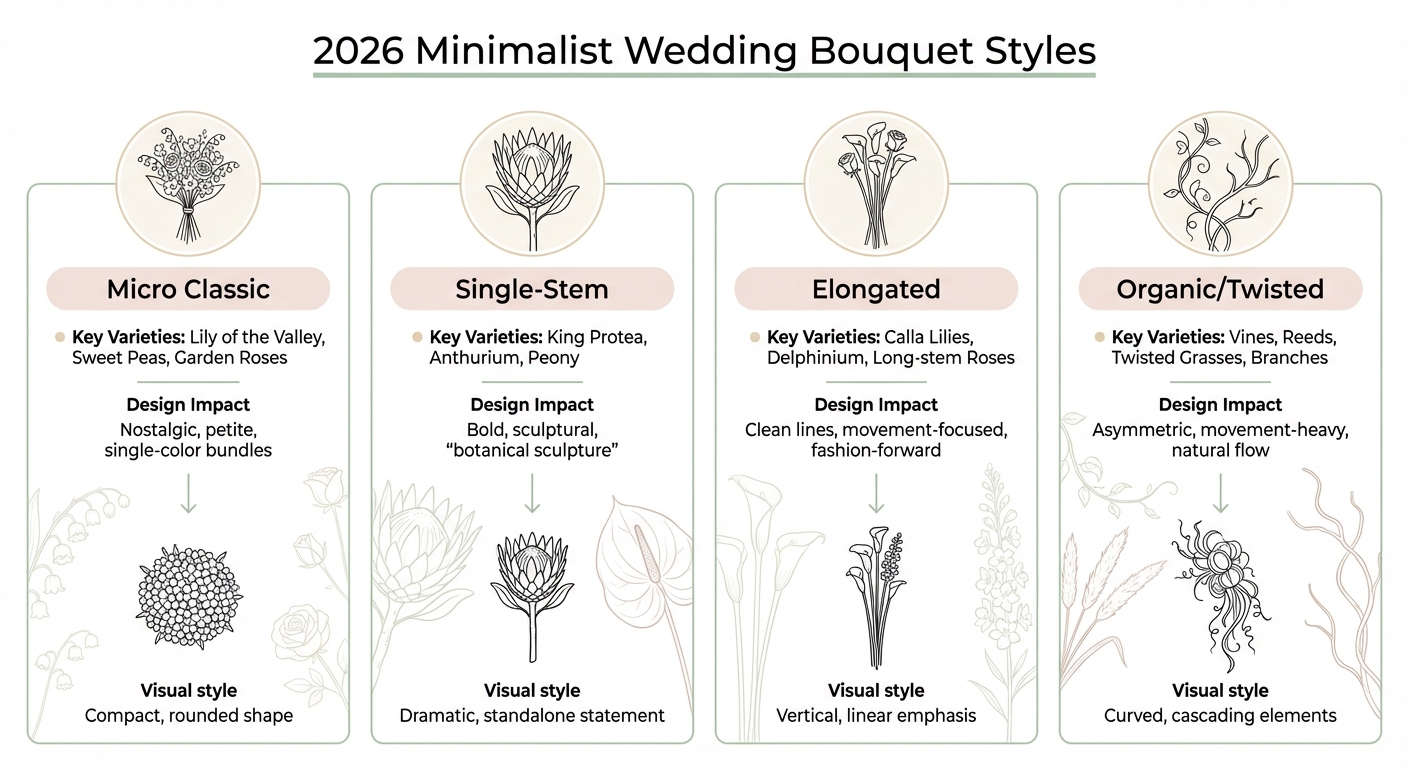
2026 Minimalist Wedding Bouquet Styles Comparison Guide
Smaller bouquets are redefining the idea of floral luxury. Instead of relying on sheer volume, the focus has shifted to intentionality - selecting a standout bloom or a few premium stems to craft what designers describe as "focused moments of beauty". This style highlights the natural line of the stem, the curve of the bloom, and organic movement, moving away from traditional symmetry and dense arrangements.
Small Bridal Bouquets
The trend toward refined simplicity is especially visible in bridal bouquets. Petite, airy arrangements emphasize quality over quantity, with micro bouquets becoming a fresh take on bridal style. These tiny bundles, often featuring a single bloom like lily of the valley, garden roses, or sweet peas, evoke a sense of nostalgia paired with minimalism. Polina Bronstein from THE WED explains:
Small is having a serious moment. Micro vintage bouquets are bringing back the old-world charm... but with a modern, minimalist twist.
Compact designs like these work well because they enhance, rather than overshadow, the bride's silhouette. Long, exposed stems are particularly favored, creating an elegant extension of the gown instead of forming a tight cluster. Brides are also gravitating toward bold statements, sometimes choosing a single, extraordinary bloom as their bouquet centerpiece.
Single-Stem Arrangements
This minimalist approach extends beyond bouquets to reception décor. Single-stem arrangements, often displayed in bud vases, bring a clean and modern aesthetic to tables. These displays leave room for conversation and additional elements like candles, creating an inviting atmosphere. Using varying heights for the vases adds a sense of movement while maintaining a curated, uncluttered look. Sculptural blooms such as anthuriums or calla lilies shine in these arrangements, with their striking silhouettes serving as focal points. Interestingly, the global cut flowers market is expected to grow from $35.12 billion in 2025 to $61.72 billion by 2035, driven in part by the popularity of these high-impact, minimalist designs.
Trailing Vines and Organic Textures
Trailing elements introduce natural movement to minimalist designs without adding heaviness. Flowers like amaranthus, with its velvety cascading form, create a sense of flow in both arches and bouquets. Meanwhile, twisted grasses, bear grass, and Grevillea contribute texture and depth while maintaining the airy aesthetic. This aligns with the "Ondular" trend, which emphasizes natural curves - think calla lilies bent into soft arcs or spiraled bear grass. These arrangements feel more "grown" than constructed, with sprawling vines and asymmetrical branches lending an effortlessly natural appearance.
For couples on tighter budgets, a hybrid approach - combining high-quality silk florals with fresh blooms - can cut costs by 30% to 50% while still achieving the desired minimalist look.
| Trend Style | Key Varieties | Design Impact |
|---|---|---|
| Micro Classic | Lily of the Valley, Sweet Peas, Garden Roses | Nostalgic, petite, single-color bundles |
| Single-Stem | King Protea, Anthurium, Peony | Bold, sculptural, "botanical sculpture" |
| Elongated | Calla Lilies, Delphinium, Long-stem Roses | Clean lines, movement-focused, fashion-forward |
| Organic/Twisted | Vines, Reeds, Twisted Grasses, Branches | Asymmetric, movement-heavy, natural flow |
At Marietta Floral Design (https://mariettafloraldesign.com), we incorporate these principles into our handcrafted designs, offering a contemporary and refined touch to every wedding celebration.
Installation Styles and Greenery
Wedding florals in 2026 are taking on a whole new role - becoming architectural features that reshape spaces with bold, striking silhouettes. These designs focus on using negative space and fewer stems to create a dramatic effect. As Rinlong Flower explains:
The defining wedding floral trend of 2026 is the shift from passive table centerpieces to immersive, architectural art installations that fundamentally alter the venue's space and acoustics.
Sustainability continues to play a key role. Designers are turning to reusable materials like metal frames, stainless steel armatures, and chicken wire. By blending high-quality faux stems with fresh flowers in visible areas, couples can save 30%–50% on costs. To put it in perspective, a fresh flower wall can cost anywhere from $5,000 to $9,000, while a hybrid version runs between $1,500 and $3,000. These installations go beyond simple bouquets, transforming entire venues into artistic spaces.
Hanging Greenery and Suspended Installations
Suspended floral clouds are defining the look of 2026 weddings. These overhead arrangements use negative space to create intimacy by visually lowering ceilings, all while keeping tables free of clutter. However, fresh floral installations can be quite heavy due to their water content. To tackle this, designers often use the "Hot-Dog Roll" technique - rolling chicken wire into lightweight tubes to hold stems instead of relying on heavy, wet foam.
Costs for ceiling clouds vary widely. Fully fresh designs range from $4,000 to $8,000, while hybrid versions (a mix of faux and fresh elements) are priced between $2,000 and $4,500. Faux greenery also allows couples to customize the atmosphere with signature scents from diffusers, avoiding any clash with natural floral aromas.
Low Centerpieces and Table Garlands
Low-profile arrangements, often called "Meadow-Core", are replacing tall centerpieces. These designs create the illusion of flowers growing directly from the table or floor. Moss, grasses, and delicate blooms like sweet peas are common elements, giving these arrangements a "sunken meadow" feel.
For example, using bleached foliage in shades of ivory, taupe, and sage can create a "Duna" aesthetic, which emphasizes texture and subtle, earthy tones. As the team at Florists' Review explains:
Simple, minimalistic designs celebrate a visual break as well as the texture of earthy elements.
Asymmetrical, natural growth patterns are also popular, adding a sense of motion and life without overwhelming the space.
Bleached Elements and Architectural Forms
Bleached elements are gaining popularity for their ability to enhance minimalist designs with modern, sculptural accents. Dried stems, translucent leaves, and bleached varieties like Grevillea, Banksia, and smokebush bring depth to monochromatic palettes. This trend is especially effective in "Brutalist Bliss" designs, which focus on sharp, intentional angles using rigid branches or structural tropicals.
Architectural blooms like King Protea, Anthuriums, and Calla Lilies are standout choices for their striking silhouettes. Calla Lilies, in particular, offer flexibility, as their stems can be shaped into curves or knots to highlight their linear beauty. Some designers are also incorporating unexpected materials like branches, metal frames, stone, or even vegetables like artichokes to introduce rich, matte textures reminiscent of "Old World" aesthetics. As Fátima Falcón García from Momentos Weddings & Events puts it:
Minimal floral design is not about doing less, but about choosing carefully. Space becomes part of the design, allowing each element to breathe.
At Marietta Floral Design, we bring these principles to life, creating custom installations that balance architectural precision with natural beauty for couples across Metro Atlanta.
Conclusion
Minimalist wedding florals in 2026 embrace the idea of quality over quantity. Instead of large, elaborate arrangements, the focus has shifted to designs that highlight the beauty of each individual flower. As Lisa Cotte from The Sunday Floral Studio puts it:
With a petite bouquet, the focus shifts to the quality of each bloom, celebrating each flower in a way that feels refined, timeless and contemporary.
This year’s trends emphasize architectural shapes, intentional use of space, and eco-conscious choices. Couples are gravitating toward sculptural blooms like Calla lilies and Anthuriums, soft monochromatic palettes in shades like pale lemon and white, and arrangements that serve multiple purposes, such as transitioning seamlessly from ceremony to reception. The result? A sleek, editorial aesthetic where every stem is thoughtfully selected.
Crafting such designs requires precision, ensuring that every element contributes to a harmonious balance of movement, texture, and form - without relying on sheer volume. Each piece tells a story, combining elegance with purpose.
At Marietta Floral Design, we bring these principles to life with custom arrangements that are locally sourced and hand-delivered across Metro Atlanta. Whether you’re envisioning a petite bridal bouquet, dramatic suspended installations, or striking sculptural centerpieces, we’re here to help you create a wedding look that’s both modern and timeless.
FAQs
How do I keep minimalist flowers from looking sparse?
To make minimalist flower arrangements look complete yet purposeful, pay attention to texture, movement, and layering. Incorporate textured flowers like lisianthus or anemones to add depth, and stick to tone-on-tone color schemes for a more sculptural vibe. Use greenery or green-hued blossoms to fill gaps subtly, keeping the design airy. By balancing open spaces with thoughtfully selected blooms, you can achieve a minimalist look that feels both full and harmonious.
Which statement bloom works best with my venue style?
The ideal statement bloom for your venue style is one that boasts a sculptural design with bold movement and an eye-catching flair. This approach aligns with 2026 trends, emphasizing fearless, modern floral arrangements that leave a memorable impression.
What’s the cheapest way to create a hanging floral installation?
To cut costs, consider using simple, in-season flowers such as roses, carnations, or chrysanthemums. Smaller, straightforward designs can also help keep expenses down. Sourcing flowers locally is another great way to save, as it reduces transportation costs. Additionally, selecting hardy blooms and limiting the use of extra materials can make installations more budget-friendly.